What Part of a Translator Has Been Replaced?
AI can now translate text, drafts, menus, emails, and huge volumes of content fast. But it has not replaced nuance, tone, culture, idiom, or the accountability for high-stakes legal and medical accuracy.
Bottom line — AI replaced the literal, high-volume part of translation. It has not replaced the human judgment behind it.
The simple answer
A translator does not just swap words from one language to another.
A translator carries meaning, tone, and intent across cultures.
A translator knows when a phrase would offend, confuse, or fall flat.
AI can convert text very fast.
But AI does not fully understand context, culture, or what is at stake if it gets the meaning wrong.
Bottom line — AI can translate words. Humans still decide if the meaning is right.
Main idea
AI has replaced the fast, literal, high-volume part of translation. It has not replaced the judgment part of translation.
The translator job, broken into simple parts
Columns
| Part of the job | Can AI do it? | How well? | Human still needed? | Simple example | Real answer |
|---|---|---|---|---|---|
| Translate plain text | Yes | Extremely well | Barely | Translate an email or a paragraph | Mostly replaced |
| Translate at high volume | Yes | Extremely well | Sometimes | Translate a 500-page manual overnight | Mostly replaced |
| Produce a rough first draft | Yes | Very well | Yes, to refine | Get the gist of a foreign article | Mostly replaced |
| Real-time spoken translation | Yes | Good and improving | Yes, for nuance | Translate a live conversation on a phone | Partly replaced |
| Translate idioms and jokes | Somewhat | Weak | Yes | Make a pun work in another language | Not fully replaced |
| Match tone and voice | Somewhat | Medium | Yes | Keep a brand sounding warm, not robotic | Not fully replaced |
| Adapt for culture | Somewhat | Weak | Yes, strongly | Avoid a phrase that offends a region | Not replaced |
| Legal and medical accuracy | Somewhat | Risky | Yes, strongly | Translate a contract or a diagnosis | Not replaced |
| Take responsibility | No | Cannot | Yes | Who is liable if the translation is wrong? | Not replaced |
The easiest way to understand it
AI can produce a sentence that reads fluently.
That does not mean it carries the right meaning.
A fluent sentence can still be culturally wrong.
A correct-looking translation can still flip the intent.
A fast translation can still be dangerous in a hospital or a courtroom.
Bottom line — AI can make fluent text. Humans decide if it means the right thing.
What moved to AI, and what stayed human
AI handles the literal layer
Word-for-word and sentence-level conversion is now fast, cheap, and usually fluent for common languages.
AI drafts; humans edit
The common workflow is now machine translation plus human post-editing, not translation from scratch.
Humans keep the meaning layer
Tone, idiom, humor, register, and cultural fit are judgment calls a model approximates but does not own.
Humans keep the risk layer
In legal, medical, and safety contexts, a person must verify and answer for the result.
Bottom line — The literal layer moved to AI. The meaning layer and the risk layer stayed human.
old translator work vs AI-era translator work
Before AI
- Translate every sentence by hand.
- Spend hours on a first draft.
- Look up terms one by one.
- Turn around large documents slowly.
- Charge mostly for raw word count.
With AI
- AI produces the first draft.
- Human reviews, fixes, and refines.
- AI handles glossary and consistency.
- Large documents move much faster.
- Human is paid for judgment, not typing.
Bottom line — The job moved from converting every word by hand to editing, adapting, verifying, and answering for the result.
Important distinction
AI can make a sentence read fluently. That does not mean it means the right thing in the right culture for the right stakes.
What stays human (and what a translator should build)
Tone and voice
Keep a text sounding human, on-brand, formal or warm as the situation demands.
Idiom and humor
Make jokes, puns, and sayings land instead of translating them literally.
Cultural adaptation
Know what offends, confuses, or simply does not transfer between cultures.
High-stakes accuracy
Verify legal, medical, and safety text where a wrong word causes real harm.
Accountability
Be the person who signs off and answers for the final translation.
AI as leverage
Use machine translation for the draft, then spend your time on the parts only a human can do.
But what about…
But isn't the whole job gone?
“If AI translates instantly and for free, the translator's job is gone.”
The fast, literal, high-volume part is largely automated. But that was never the whole job. Tone, idiom, culture, and high-stakes accuracy still need a human. The work shifts from typing translations to editing, adapting, and verifying them. Post-editing machine output is now a core skill, not a sign the role disappeared.
“AI keeps getting better, so it will replace the rest soon.”
Fluency has improved fast. Judgment and accountability have not transferred. A model can suggest a phrasing, but it cannot be liable for a mistranslated contract or a wrong dosage. Someone has to verify and own the result. That responsibility stays with a person regardless of how good the draft gets.
The new job of a translator
The old job was: translate the words.
The new job is: know what the message should do, let AI produce a draft, fix what it gets wrong, adapt it for the culture, protect the tone, verify the high-stakes parts, and stand behind the result.
Bottom line — The translator becomes the editor, cultural guide, accuracy check, and the person who is accountable.
Brutal truth
If you only convert words, AI is dangerous. If you carry meaning, tone, culture, and responsibility, AI becomes leverage.
Why advanced AI changes the answer
Old tools helped translators work faster.
New AI tools can produce a usable draft on their own.
They can translate emails, documents, websites, and live speech from a simple request.
So AI is no longer only assisting translators.
It is doing large parts of the literal translation itself, and the human is moving up the chain to judgment and trust.
Bottom line — AI is not just speeding up translation. It is doing the literal part, and pushing humans toward meaning and risk.
Final definition
AI has replaced much of literal translation. It has not replaced the human ability to carry meaning across cultures and answer for it.
Sources
Sources
Reference links on machine translation, real-time speech translation, post-editing, and the limits of AI in high-stakes contexts.
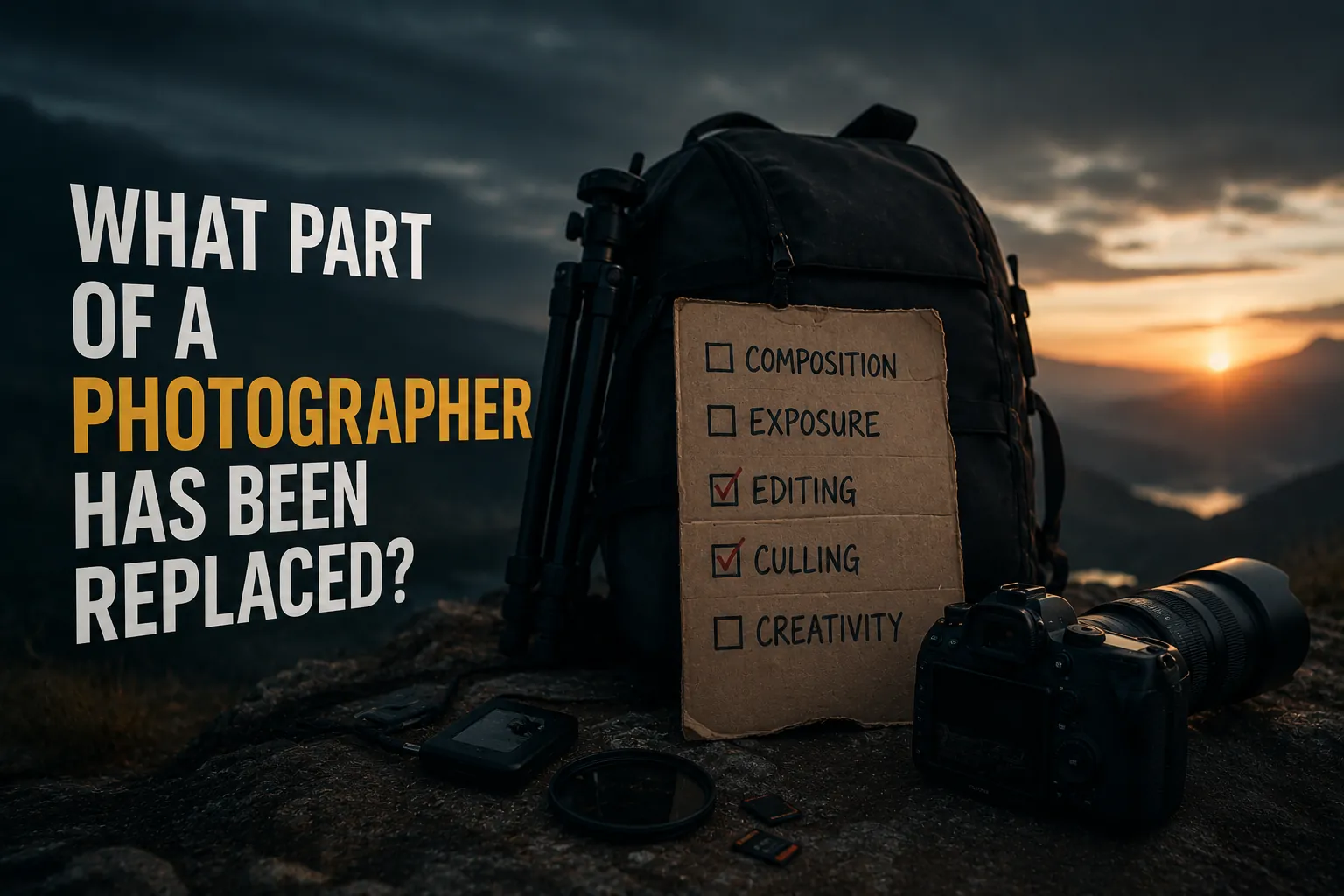
What Part of a Photographer Has Been Replaced?
AI now generates images, retouches faces, and fixes lighting — but being there, capturing real moments, and authenticity still need a human.