What Part of a Salesperson Has Been Replaced?
AI can now score leads, draft outreach, write CRM notes, schedule follow-ups, and answer product questions very fast. But it has not replaced trust, reading the room, negotiation, or closing complex deals.
Bottom line — AI replaced a lot of sales busywork. It has not replaced the human part of the deal.
The simple answer
A salesperson is not just someone who sends messages.
A salesperson finds the right people to talk to.
A salesperson builds trust, handles doubt, and helps a buyer decide.
AI can do the fast, repeatable parts of selling.
But AI does not truly understand the buyer, the pressure they feel, or what it takes to earn their trust.
Bottom line — AI can do sales tasks. Humans still close the deal.
Main idea
AI has replaced the fast, repeatable part of selling. It has not replaced the trust part of selling.
The salesperson job, broken into simple parts
Columns
| Part of the job | Can AI do it? | How well? | Human still needed? | Simple example | Real answer |
|---|---|---|---|---|---|
| Score and rank leads | Yes | Very well | Sometimes | Rank 1,000 leads by who is likely to buy | Mostly replaced |
| Find new contacts | Yes | Very well | Sometimes | Build a list of likely buyers | Mostly replaced |
| Draft cold outreach | Yes | Very well | Yes, to edit and aim it | Write a first email or LinkedIn message | Mostly replaced |
| Write CRM notes | Yes | Very well | Barely | Summarize a call into the CRM | Mostly replaced |
| Schedule follow-ups | Yes | Very well | Barely | Send a reminder after a meeting | Mostly replaced |
| Answer product questions | Yes | Well | Yes, for hard cases | Explain a feature or a price tier | Partly replaced |
| Build trust with a buyer | Somewhat | Weak | Yes | Make a cautious buyer feel safe | Not replaced |
| Read the room | Somewhat | Weak | Yes | Notice the real worry behind a question | Not replaced |
| Negotiate and close | No | Cannot | Yes | Agree terms on a big, complex deal | Not replaced |
What moved and what stayed
The repeatable work moved to AI.
Lead scoring, list building, first-draft emails, call notes, and reminders are now fast and cheap.
The human work stayed.
Trust, judgment, and pressure cannot be prompted.
The deal still closes between two people.
Bottom line — The busywork moved to AI. The relationship and the close stayed human.
How AI now fits into the sales day
AI finds and ranks leads
It scores who is most likely to buy, so the human starts with better odds.
AI drafts the outreach
It writes a first email or message. The human edits it and adds context.
Human runs the conversation
The human builds trust, reads tone, and handles the real objections.
AI writes the notes and follow-ups
It logs the call into the CRM and schedules the next step automatically.
Human negotiates and closes
The human agrees terms, takes the risk, and owns the result.
Bottom line — AI handles the start and the admin. The human owns the middle and the close.
What stays human in sales
Building trust
Buyers buy from people they believe. AI can draft, but it cannot earn belief.
Reading the room
Noticing hesitation, fear, or a hidden decision-maker is a human skill.
Handling real objections
The stated reason is rarely the real reason. Humans dig for the truth.
Negotiation
Trading on price, scope, and timing under pressure needs human judgment.
Closing complex deals
Big deals with many stakeholders still come down to a human relationship.
Owning the outcome
Someone has to be responsible if the deal goes wrong. AI cannot be.
Bottom line — Trust, judgment, and responsibility are the parts AI does not touch.
But what about…
But isn't the sales job just gone?
“If AI can find leads, write the emails, and log the calls, the salesperson is gone.”
No. The tasks that left were the tasks nobody bought from. People do not buy because of a clean CRM or a fast email. They buy because a person they trust helped them decide. AI removed the busywork around the deal, not the deal itself. The role shifts toward fewer, harder conversations where trust and judgment matter most.
“Chatbots already answer product questions, so buyers don't need a rep.”
Chatbots handle simple, common questions well. But a large or risky purchase raises questions a script cannot answer: Will this work for our exact situation? Who is accountable if it fails? Can we trust you? Those answers come from a human who can be held responsible.
The new job of a salesperson
The old job was: do everything by hand.
Find the leads, write every email, log every call, chase every follow-up, and somehow also close.
The new job is narrower and harder.
Let AI handle the volume. Spend your time on the few conversations where trust, reading the room, and negotiation decide the deal.
The best salespeople use AI as leverage, not as a replacement for the relationship.
Bottom line — The rep becomes a trusted advisor who uses AI to skip the busywork.
Final definition
AI has replaced much of the busywork around the deal. It has not replaced the human ability to earn trust and close it.
Sources
Sources
Evidence links for AI in sales: lead scoring, outreach drafting, CRM note-taking, follow-ups, and AI sales agents.
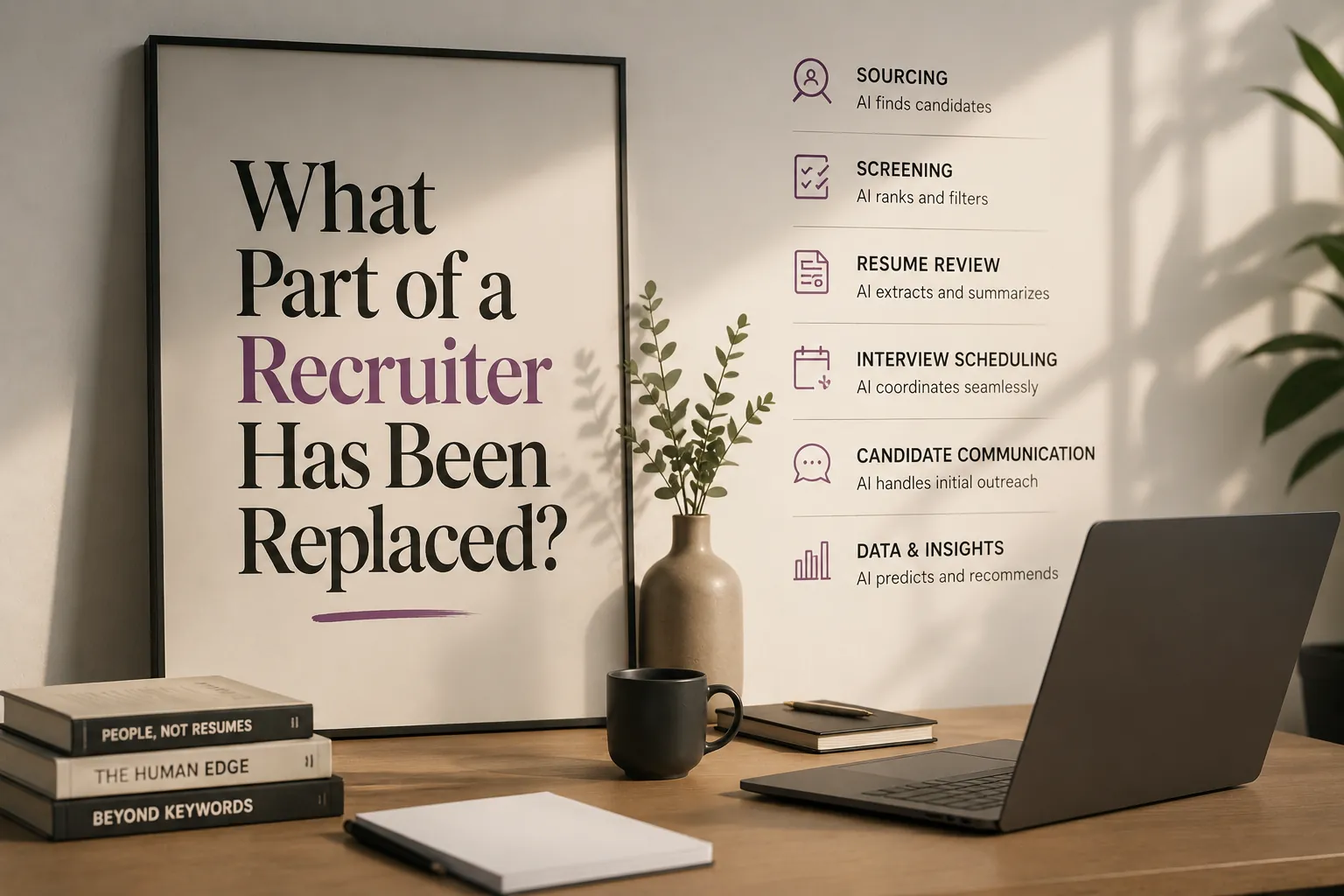
What Part of a Recruiter Has Been Replaced?
AI now sources candidates, screens resumes, and schedules — but judging real fit, candidate experience, and the hiring call still need a human.