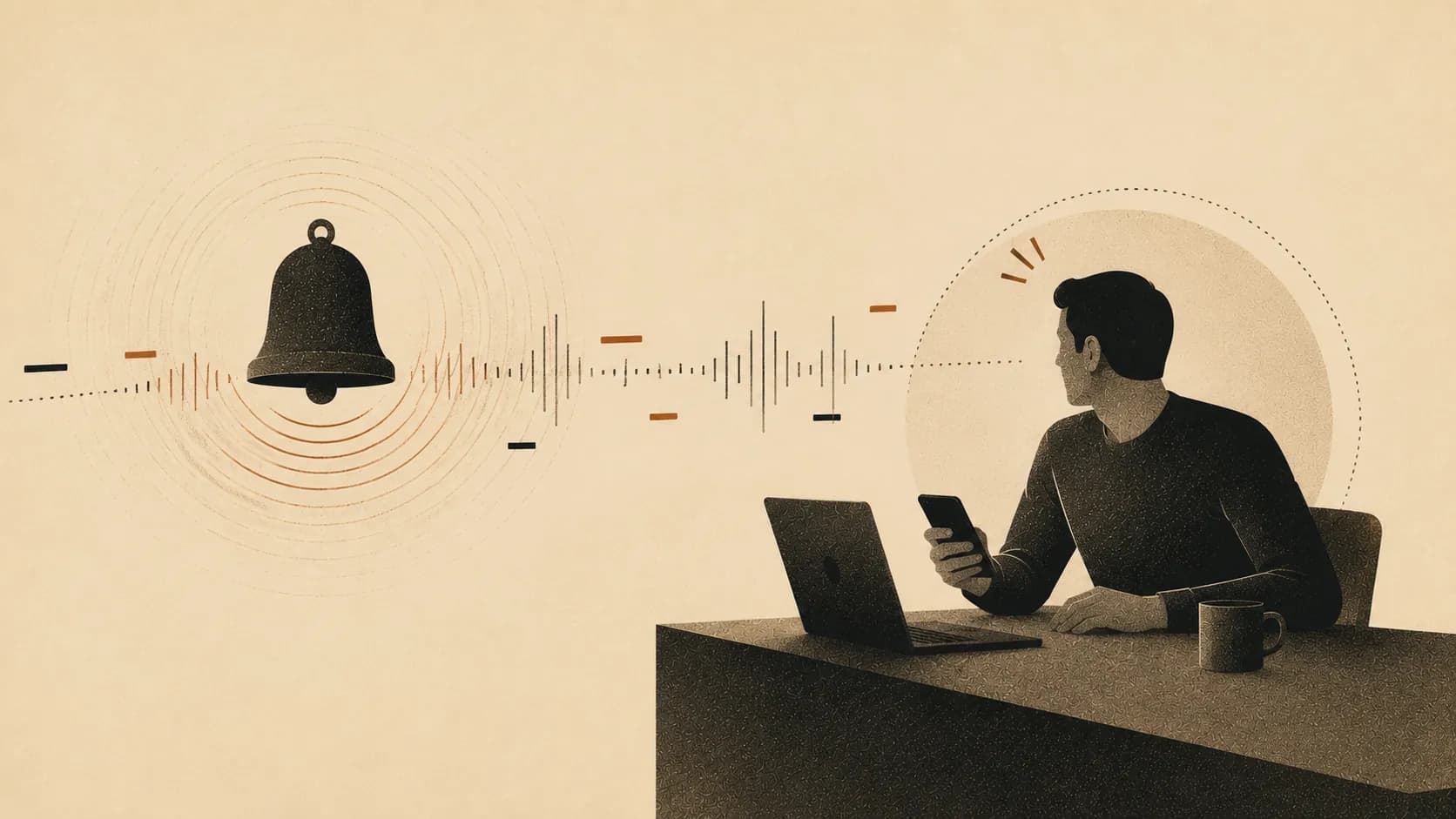
The invisible spectator
When your life becomes an audience
Public approval feels like proof until your private choices start needing invisible spectators.
By the end, you'll see why the watcher in your head feels normal, and why it may be stealing your life before you even post.
You are alone in your room.
Nobody is watching. Nobody is clapping. Nobody is judging the angle, the outfit, the meal, the book, the face, the tiny corner of your life sitting in bad lighting.
Still, some part of you checks.
How would this look?
That is where the problem begins.
The strange part is how ordinary it feels.
You go for coffee and notice the cup before the taste. You clean your desk and think about the photo before the work. You feel sad and a caption appears before the feeling finishes forming.
You are living.
Then another part of you is standing slightly outside the moment, checking whether the moment can be used.
That second self is quiet at first.
Then it becomes management.
How your life becomes an audience
You share one piece
A meal, a win, a joke, a face, a private feeling made safe enough for public view.
The response lands
Likes, replies, views, silence, praise, small signals that tell you what worked.
Your brain remembers
The next time something happens, you already know which version might be rewarded.
The watcher appears earlier
You start editing before posting, then before speaking, then before choosing.
The audience moves inside
Even when nobody is there, you feel the room they might become.
This is the curtain most people never pull back.
The audience does not stay on the screen.
It follows you into the moment before the screen appears.
It sits beside you when you choose clothes. It stands in the corner when you arrange your room. It watches your vacation while you are still on it. It whispers during dinner with friends, "This could look good."
Then, slowly, life stops being something you enter.
It becomes something you prepare for inspection.
The feed wins when private experience becomes raw material for public proof.
Public approval feels clean because it arrives as a number.
10 likes. 200 views. 3 replies. No replies. A heart from the person you hoped would see it. Silence from the person you posted for without admitting it.
Numbers feel objective.
So the pain feels objective too.
If it landed, you feel real for a minute. If it disappeared, you wonder what was wrong with it.
Then the darker thought appears.
What was wrong with me?
The audience moves inward
The damage rarely announces itself. It enters as a habit of checking.
- 01The momentYou stop feeling things fully because you are already packaging them.
- 02The bodyYou see yourself from the outside before you feel yourself from the inside.
- 03The choiceYou ask what will look right before asking what is true.
- 04The identityYou become attached to the version of you that gets the best response.
- 05The soulYou begin needing witnesses before your own life feels convincing.
visible life
The audience gets inside when looking impressive becomes one of the pressures young people carry.
The pressure to look like something
Most teens feel pushed to have a future, achievements, and appearance worth showing
You are not just choosing what to do next. You are measuring whether it looks like a life that is going somewhere, a face that is acceptable, a story that can be defended.
How to read thisEach bar is the share of U.S. teens who feel pressure in that part of life.
Pressures reported by U.S. teens ages 13 to 17 in a nationally representative 2023 survey.
Notice56% feel pressure to have their future figured out, and 51% feel pressure to look or present themselves a certain way.
If your choices feel like they need to prove something, the audience may already be shaping the life before anyone sees it.
Behind the numbers
Source: Common Sense Media, Center for Digital Thriving at Harvard Graduate School of Education, and Indiana University Lilly Family School of Philanthropy, 2024 report using a nationally representative SSRS survey of 1,545 U.S. teens ages 13 to 17 conducted Oct.-Nov. 2023. Reported pressures: future life path 56%, achievement 53%, appearance/presentation 51%, active visible social life 44%, friendship availability 41%, activism/informed citizenship 32%. Self-reported pressure, not causation.
Verify the data ↗Bottom line — A life becomes easier to perform when even your goals, face, friendships, and goodness start feeling like they need public evidence.
Try this
When did your private life start needing evidence before it felt real?
The dangerous part is that nobody has to force you.
No one says, "Turn your grief into a post."
No one says, "Make your breakfast prove you are disciplined."
No one says, "Turn your relationship into evidence that you are desired."
The machine does not need to command you.
It only needs to reward you often enough that you begin arriving pre-edited.
The deepest control is the one that feels like your own idea.
Once approval becomes the proof, you start living with an imaginary witness.
You do not need thousands of followers for this.
20 people can do it.
A class group can do it. A friend circle can do it. A private story can do it. One person you secretly want to impress can do it.
The audience can be tiny and still take up the whole room.
Reinforcing loop
The path if you keep going
You feel unsure of yourself
A private moment feels incomplete without confirmation.
You share for proof
The audience gives a signal, or withholds one.
The signal changes your mood
Approval lifts you. Silence shrinks you.
You trust yourself less
Your own experience starts needing outside validation.
You share again
The same system that weakened your center becomes the place you go to borrow one.
feeds the start
Keep heading in that direction and your life will still look normal.
That is what makes it scary.
You will still go to work. Still meet friends. Still buy groceries. Still laugh. Still take photos. Still say you are just documenting your life.
But inside, something will be rearranged.
A beautiful moment will feel unfinished until it is witnessed.
A hard moment will feel wasted unless it becomes meaningful to someone else.
A private win will feel smaller if nobody knows.
A quiet season will feel like disappearing.
You will begin to fear ordinary life because ordinary life does not prove enough.
The cost of constant proof is that your own experience stops being enough witness.
This is how people become lonely in public.
They are seen all day, but rarely met.
They are reacted to, but rarely known.
They are approved of, but only through fragments they selected under pressure.
A post can receive attention without giving you intimacy.
A story can be viewed by everyone and still leave the real feeling untouched.
Visibility can imitate connection so well that you stop noticing the difference.
But what about…
The honest pushback
“Sharing can be real.”
Yes. A shared moment can connect people. The danger begins when the moment feels incomplete unless it is shared.
“I like documenting my life.”
Good. Memory is human. The problem starts when documentation becomes performance before the memory has even formed.
“Approval is normal to want.”
Of course. Humans need recognition. The wound opens when recognition becomes the only thing that makes your choices feel valid.
“I do not care what people think.”
Maybe. Watch your body when a post does badly. The truth often shows up there before it reaches language.
The most personal damage is subtle.
You lose the right to be unseen.
Not because someone took it from you directly.
Because you forgot how to choose it without feeling irrelevant.
A day with no proof starts feeling like a day that did not count. A friendship with no photos starts feeling less real. A body that is not displayed starts feeling unconfirmed. A thought that is not posted starts feeling unfinished.
That is not connection.
That is dependence wearing nice lighting.
What it quietly changes in you
Your joy
You start checking whether happiness looks convincing instead of letting it move through you.
Your sadness
You begin turning pain into something clean enough to be received.
Your body
You see angles before sensations.
Your friendships
Moments with people become potential evidence of belonging.
Your ambition
Work starts needing public milestones before it feels meaningful.
Your rest
Doing nothing feels suspicious because nothing cannot be witnessed well.
Your identity
You become loyal to the version of you that gets the best response.
The real question is not whether you post.
The real question is whether you can still have a life that refuses to become content.
Can you eat something beautiful and let it disappear?
Can you love someone without turning the relationship into proof?
Can you work quietly without feeling behind?
Can you be sad without making the sadness legible?
Can you have a good day that nobody knows about?
If the answer feels uncomfortable, the audience has moved closer than you thought.
The private test
“Freedom is the ability to live a moment without asking how it will look to someone who is not there.”
The way back starts with small refusals.
Leave one good meal unposted.
Let one outfit exist only in the day it was worn.
Tell one person the real story instead of giving many people the polished version.
Keep one win private long enough to feel it before it becomes information.
Walk without recording. Cry without wording it. Rest without proving you deserved rest.
These acts may feel tiny.
They are not tiny if your life has been trained to report itself.
The way back to a private center
You do not need to disappear. You need to belong to yourself again.
- 01Pause before captureAsk whether the moment wants memory or performance.
- 02Feel before framingLet the emotion finish before turning it into language.
- 03Share downwardTell the people close enough to care, not the crowd large enough to react.
- 04Keep sacred zonesProtect parts of love, grief, work, and joy from public measurement.
- 05Trust unwitnessed lifeLet ordinary days count even when nobody can verify them.
Once you see this, the phone changes shape.
It is no longer just a tool for sharing.
It is also a tiny courtroom, a mirror, a stage, a scoreboard, a doorway, a drug, a witness, and sometimes a thief.
The thief does not always steal time.
Sometimes it steals first contact.
The first bite. The first look. The first feeling. The first honest response before you wondered what someone else would think.
That is the life you are trying to get back.
You do not need a larger audience. You need a self that can feel real without one.
This is the solved mystery.
Your life did not become an audience because you posted too much.
It became an audience when approval became the silent witness you carried into private choices.
The exit is not shame.
The exit is ownership.
Some moments are allowed to exist without becoming proof. Some joys are allowed to leave no record. Some grief is allowed to be held by 1 trusted person instead of translated for a crowd.
Some days are allowed to matter because you lived them.
That should be enough.
It has to become enough again.
A life becomes yours again when it no longer needs spectators to feel real.
Sources
Sources
Research-backed starting points on imagined audiences, self-presentation, context collapse, and how social media feedback can shape behavior and self-worth.
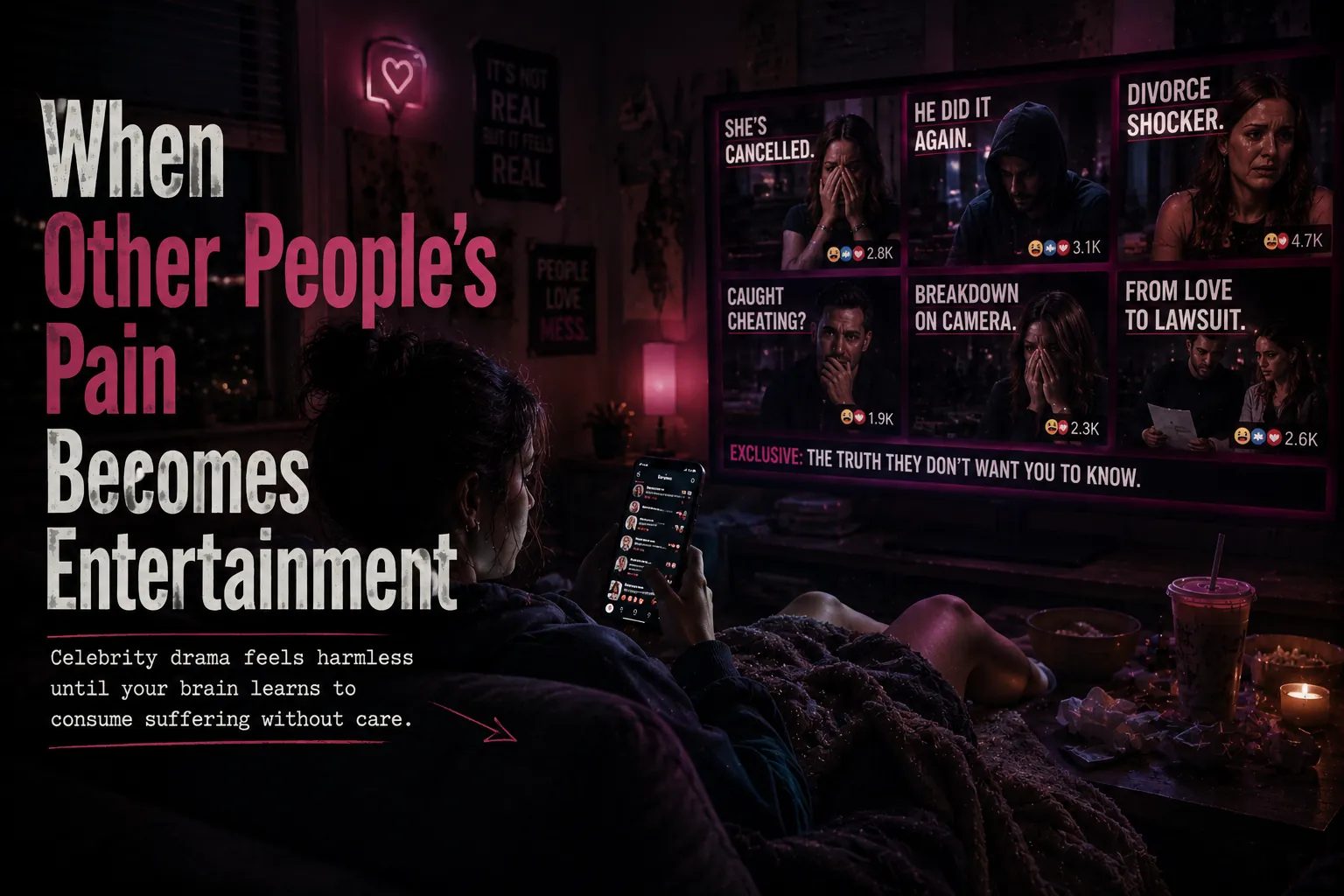
When Other People’s Pain Becomes Entertainment
Celebrity drama feels harmless until your brain learns to consume suffering without care.