The quiet separator
Humans still own taste
Taste decides which output fits the moment instead of merely existing.
By the end, you'll see why AI can make many versions, but humans still decide which one deserves to live.
AI can give you 10 options.
10 headlines. 10 logos. 10 email drafts. 10 product names. 10 captions. 10 slide designs. 10 versions of the same idea, each one clean enough to pass at a glance.
At first, that feels like power.
Then the harder question arrives.
Which one is actually good?
The real skill
“Taste begins where abundance stops being helpful.”
The problem used to be shortage.
You needed more ideas, more drafts, more angles, more examples, more starting points.
AI changes that.
Now the room fills quickly.
There are more words than attention. More designs than decisions. More answers than standards. More content than care. More output than anyone knows what to do with.
When output becomes cheap, choosing becomes expensive.
The future belongs to people who can tell the difference between finished-looking work and work that actually fits.
How taste works
The output appears
A draft, design, answer, name, plan, edit, image, or idea arrives.
The surface looks acceptable
It is clean, fluent, balanced, and easy to approve.
A human notices the mismatch
The tone is wrong, the timing is off, the idea is soft, the detail is missing, or the work has no pulse.
Standards enter the room
What is this for? Who is it for? What should it make someone feel, understand, trust, or do?
Taste chooses
The human keeps, cuts, reshapes, rejects, or rebuilds until the work fits the moment.
Taste is easy to misunderstand.
People think it means preference.
I like this color. I like this sentence. I like this style. I like this vibe.
That is only the surface.
Real taste is judgment with a standard.
It can explain why one version works and another one merely exists.
It can feel the difference between clear and plain, emotional and manipulative, confident and loud, simple and thin, polished and dead.
Taste is the ability to notice when something is technically fine and still not right.
This is why weak work spreads so easily now.
It does not look broken.
Broken work is easy to catch.
The real danger is smooth work with no center.
An essay that says nothing beautifully. A slide deck with clean icons and weak thinking. A brand that looks expensive and feels empty. A post with rhythm but no earned insight. A product feature that works, but solves the wrong annoyance.
AI can make average work look dressed.
Taste notices the body underneath.
The layers of taste
Taste is not one instinct. It is a stack of seeing.
- 01FitDoes this belong in this moment?
- 02WeightIs the tone strong enough for the stakes?
- 03ClarityCan the right person understand it quickly?
- 04RestraintWhat should be removed so the point can breathe?
- 05TextureDoes it feel human, specific, and alive?
- 06StandardCompared with excellent work, where does this fall short?
- 07CourageAre you willing to reject the easy option?
Try this
When AI gives you 10 decent options, what standard decides the one you keep?
Taste matters because most bad decisions do not announce themselves as bad.
They arrive as acceptable.
The acceptable headline. The acceptable hire. The acceptable apology. The acceptable landing page. The acceptable explanation. The acceptable product choice. The acceptable idea that nobody hates and nobody remembers.
Acceptable is seductive because it avoids conflict.
Great work usually asks someone to care enough to be precise.
The danger zone
“Mediocrity survives by looking reasonable.”
This is the quiet skill inside every serious field.
A great editor can feel the sentence where the piece loses blood.
A great designer can see the spacing that makes the page feel cheap.
A great engineer can smell the shortcut that will become pain later.
A great teacher can tell when a student nodded without understanding.
A great founder can hear the polite customer answer and know the product did not matter enough.
That is taste.
It is earned attention.
Taste is built by staying with the work long enough to notice what average people stop noticing.
Reinforcing loop
The average-output loop
AI gives a decent version
The draft looks good enough to avoid embarrassment.
The human accepts too fast
Speed feels like progress.
The standard stays low
The work never has to fight for its place.
The audience feels little
They read, click, glance, or scroll without being moved.
More output is made
Quantity replaces the harder work of making one thing matter.
feeds the start
This loop creates a strange world.
Everyone publishes more.
Fewer things land.
Everything sounds competent.
Less of it feels necessary.
The internet fills with clean sentences that leave no bruise, no memory, no shift in the reader's body.
That is what happens when output scales faster than taste.
The world does not need more content. It needs more people who can tell what deserves attention.
But what about…
The honest pushback
“AI can learn my style.”
It can imitate patterns you give it. Taste still decides when imitation becomes stale, forced, too familiar, or wrong for the moment.
“Taste is subjective.”
Partly. Strong taste still has reasons: fit, clarity, timing, audience, craft, truth, restraint, and effect.
“Data can tell us what works.”
Data can show response. Taste asks whether the response is worth chasing and what it costs to chase it.
“Fast output matters.”
Yes. Speed helps when the standard is clear. Speed hurts when it lets weak work escape before anyone has really looked.
“Beginners cannot have taste yet.”
Beginners can build it by studying excellent work, copying for practice, getting feedback, and comparing versions honestly.
The normal person needs taste more now because AI makes everything look close enough.
Your résumé sounds professional.
Your post sounds smart.
Your essay sounds organized.
Your pitch sounds confident.
Your message sounds warm.
But "sounds" is not enough.
Does the résumé make your value obvious?
Does the post say something earned?
Does the essay reveal real thinking?
Does the pitch build trust?
Does the message sound like you, to this person, in this moment?
Where taste quietly decides
Writing
The sentence that is accurate may still be lifeless.
Design
The clean layout may still guide the eye badly.
Career
The polished résumé may still hide the strongest proof.
Product
The clever feature may still miss the real user need.
Content
The viral angle may still damage long-term trust.
Relationships
The perfect message may still feel borrowed.
Learning
The neat answer may still skip the struggle that builds understanding.
Taste also protects you from overproduction.
When you can generate endlessly, restraint becomes rare.
You can make another post, another version, another logo, another email, another slide, another plan.
But taste asks a harsher question.
Should this exist?
That question saves attention.
It saves trust.
It saves you from becoming a machine that can produce more than it can care about.
The restraint test
“Taste is knowing when more output would make the work worse.”
The path to taste is not mystical.
Look at excellent work until weak work starts to bother you.
Compare versions side by side.
Ask what changed when one version landed better.
Study people with standards higher than yours.
Save examples. Rewrite them. Rebuild them. Explain why they work. Ask for critique from people who can see what you cannot yet see.
Taste grows when exposure meets honest comparison.
How to build taste
Taste improves when you train your eye, ear, and standard.
- 01CollectSave excellent examples in your field.
- 02ComparePut strong and weak work next to each other.
- 03NameExplain what makes one version better.
- 04CopyRecreate good work to understand its choices.
- 05ReviseMake one piece better across several passes.
- 06Seek critiqueLet sharper people show you what you missed.
- 07Raise the barUpdate your standard as your eye improves.
The key move is naming.
Do not only say, "This is good."
Say why.
The opening creates tension. The button is placed where the eye already goes. The metaphor makes the idea visible. The paragraph ends before it explains itself to death. The product removes a step the user hated. The apology names harm without begging for praise.
Naming turns vague preference into usable taste.
Taste becomes stronger when you can explain what your instincts are seeing.
This is where AI can help without taking over.
Ask it for options.
Then make the options compete.
Which one is clearest?
Which one feels most honest?
Which one fits the audience?
Which one is trying too hard?
Which one says the obvious thing with expensive words?
Which one would you defend if your name were attached?
The tool creates material.
Your taste applies pressure.
Prompting for output versus using taste
Prompting for output
- Ask for 10 versions.
- Pick the one that sounds polished.
- Move on quickly.
- Trust the surface.
- Publish more.
Using taste
- Ask what the work must do.
- Compare against a standard.
- Cut what weakens the point.
- Check fit, timing, and truth.
- Publish less work that matters more.
The best creators in the AI age will look slower than they are.
They will generate fast, then choose slowly.
They will reject most of what the tool gives them.
They will keep the one line that carries heat and delete the paragraph around it.
They will notice when the design is clean but soulless.
They will refuse the viral angle that bends the truth.
They will use AI to widen the table, then use taste to clear it.
AI can multiply options. Taste protects the final choice.
The final truth is simple.
Taste decides which output fits the moment instead of merely existing.
That phrase matters: fits the moment.
A joke can be funny and wrong for the room.
A design can be beautiful and wrong for the user.
A message can be polite and wrong for the relationship.
A strategy can be clever and wrong for the company's trust.
A post can be engaging and wrong for the person you are becoming.
Good does not live in isolation.
Good has to fit.
The final line
“Taste is the human ability to feel when "good enough" is quietly betraying the thing that matters.”
So use AI.
Let it draft, sketch, remix, compare, and suggest.
Then become harder to satisfy.
Ask what the work is for.
Ask who it serves.
Ask what should be removed.
Ask where it feels fake.
Ask what makes it worth choosing from the pile.
Because the future will overflow with things that exist.
The rare thing will be work chosen by someone with taste.
Humans still own taste because taste is the standard that keeps output from becoming noise.
Sources
Sources
Research-backed starting points on aesthetic judgment, expertise, creativity, design quality, and human evaluation in AI-assisted work.
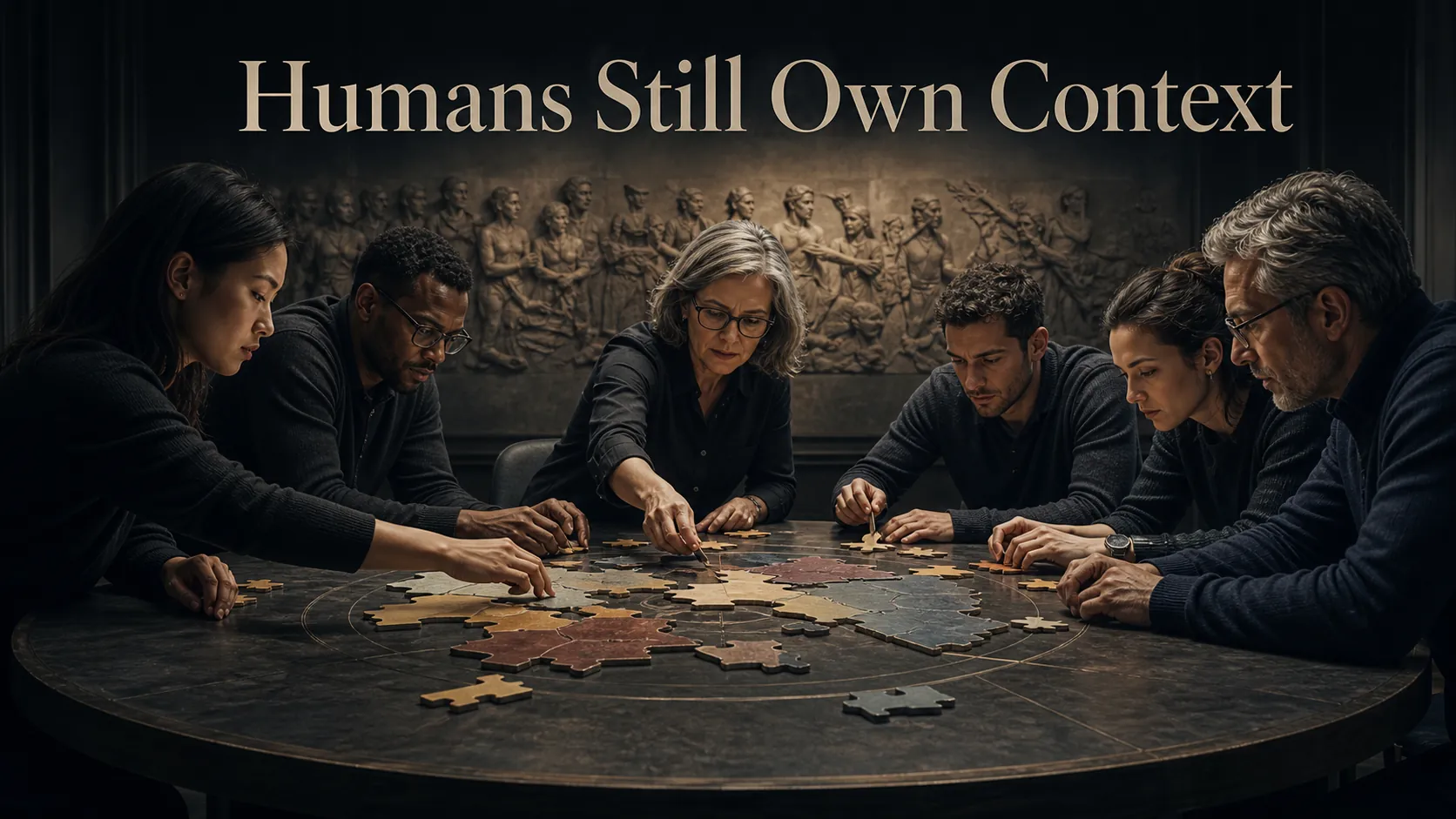
Humans Still Own Context
Context turns generic answers into useful decisions.
A different path through the library.
AI can generate quick visuals and options, but the real value is knowing what should exist and why.
What Part of a Designer Has Been Replaced?
AI can produce drafts and variations, but taste, lived insight, and trust still separate useful writing from average content.
What Part of a Writer Has Been Replaced?
AI can generate campaigns and copy fast, but positioning, taste, customer insight, and brand trust still decide outcomes.