The deployment state
The China AI position
China is an AI superpower because it combines state strategy, massive deployment, industrial capacity, surveillance infrastructure, domestic platforms, and a huge market.
By the end, you'll see China's AI position as its own system: planned, applied, industrial, domestic, and built for scale.
China's AI position cannot be understood by looking only at chatbots.
That misses the real structure.
China's strength comes from the way AI is tied into national planning, manufacturing, logistics, cities, platforms, public services, consumer apps, cloud systems, factories, finance, education, and security.
The center of the story is deployment.
China does not treat AI only as a software wave.
It treats AI as infrastructure for the economy, the state, and industrial upgrading.
The core idea
“China's AI power comes from turning AI into a national deployment system.”
The logic begins with the state.
China has treated AI as a strategic technology for years. That means AI is connected to industrial policy, local government planning, public funding, standards, regulation, universities, state-backed research, city projects, and national development goals.
This matters because AI is expensive, uneven, and slow to apply in the real world.
A strong model alone does not change a factory.
A paper alone does not change a hospital.
A startup alone does not change a city.
China's system is built to push technology into use cases at national scale.
China's AI position is strongest where strategy turns into deployment.
How China's AI power compounds
State strategy sets direction
AI is tied to economic growth, industrial upgrading, public services, governance, and national technology goals.
Platforms build domestic capability
Baidu, Alibaba, Tencent, ByteDance, Huawei, iFlytek, SenseTime, Moonshot AI, DeepSeek, Zhipu AI, MiniMax, and others create models, apps, cloud services, and industry tools.
Industrial capacity creates use cases
Factories, supply chains, robotics, logistics, electric vehicles, energy systems, and smart devices give AI places to operate.
Public systems create deployment pathways
Cities, transport, health, education, security, courts, and administrative services can become channels for AI use.
Huge markets create feedback
Large user bases produce demand, behavior patterns, business pressure, and rapid iteration.
Regulation shapes the lane
The state can permit, guide, restrict, standardize, and redirect AI use based on political, social, and economic priorities.
The first layer is state strategy.
China's government has placed AI inside national development planning rather than leaving it only to private companies.
This creates a different kind of AI position.
The government can identify target sectors, fund research, support infrastructure, guide local pilots, issue rules, and connect AI to broader goals like "AI Plus," smart manufacturing, scientific research, health care, consumption, social services, and governance.
That gives China a coordinated adoption path.
The path is not always smooth.
Local projects can waste money. Policy can move faster than product quality. Regulation can create pressure for companies. But the direction is clear: AI is expected to enter real systems.
China's AI strategy is less about isolated invention and more about organized diffusion.
What people see versus what gives China power
What people see
- A Chinese chatbot
- A facial recognition system
- A smart factory demo
- A domestic AI app
- A low-cost model release
What sits underneath
- A national push to place AI across industries and services
- Years of digital governance, camera networks, identity systems, and public security deployment
- Manufacturing depth, robotics demand, supply-chain data, and industrial policy
- Large platforms with users, payments, cloud, media, commerce, and daily behavior
- Engineering pressure created by chip limits, local demand, and intense competition
The second layer is deployment.
China has one of the world's largest environments for applying AI at scale.
Large cities, dense transport systems, digital payment habits, delivery networks, e-commerce, livestream commerce, short video platforms, factory clusters, and public administration all create places where AI can be tested and used.
This matters because AI becomes powerful when it leaves the lab.
Deployment teaches what breaks.
It reveals latency problems, cost problems, language problems, trust problems, safety problems, edge cases, and user behavior.
A country with many deployment surfaces can learn quickly.
The China AI stack
China's position is built from connected layers.
- 01State directionNational plans, local pilots, public investment, standards, and regulation push AI into priority areas.
- 02Domestic platformsMajor Chinese tech companies provide search, cloud, commerce, payments, social media, video, logistics, devices, and enterprise software.
- 03Industrial baseManufacturing, robotics, vehicles, energy, telecom, and electronics create real-world AI demand.
- 04Public-sector deploymentGovernance, city management, transport, education, health, and security create large institutional use cases.
- 05Market scaleHundreds of millions of users create speed, feedback, and commercial pressure.
- 06Data-rich environmentsConsumer platforms, industrial systems, city infrastructure, and digital services create many forms of operational data.
- 07Engineering adaptationChip constraints and local needs push companies toward efficiency, model compression, domestic hardware, and practical deployment.
The third layer is industrial capacity.
This is one of China's clearest AI advantages.
China is deeply tied to the physical economy: factories, supply chains, ports, warehouses, electric vehicles, batteries, solar, electronics, telecom equipment, drones, robotics, appliances, and smart devices.
AI does not stay abstract in this environment.
It can be used for visual inspection, predictive maintenance, warehouse routing, robotics control, demand forecasting, energy management, autonomous driving, supply-chain planning, product design, and factory optimization.
This gives China a practical AI path that runs through machines, logistics, and production.
China's AI position is unusually physical because so much of its economy gives AI a place to act.
Factory intelligence
China installed more factory robots than the next four countries combined
Picture a phone, a car part, a battery cell, a delivery scooter. Somewhere in the supply chain, a robot touched it. In 2024, more of those new robots went into Chinese factories than anywhere else by far.
How to read thisEach bar is new factory robots installed in 2024; longer means more machines added to production lines.
New industrial robots installed in 2024, in thousands of units, across the five largest visible markets.
NoticeChina installed 295,000 factory robots in one year — more than Japan, the United States, South Korea, and Germany combined.
When "made in China" becomes faster, cheaper, and more automated, the products you buy and the companies you compete with both feel it.
Behind the numbers
Source: International Federation of Robotics, World Robotics 2025. Industrial robot installations in 2024: China 295,000; Japan 44,500; United States 34,200; South Korea 30,600; Germany 26,982. Global installations were 542,000; China represented 54% of global deployments. Figures are installations, not total robots already operating.
Verify the data ↗Bottom line — China's AI power is not just clever answers; it is intelligence being bolted into the physical systems that make the world's stuff.
That is the deployment story in one number. China does not need every frontier model to be the best if its factories keep turning intelligence into output at enormous scale.
This is important because much of the world talks about AI as language.
China's position is broader.
Language models matter, and Chinese companies are building strong models.
But China's larger advantage appears when AI is connected to the real economy.
A model that improves a factory line, a delivery route, an industrial robot, a vehicle system, a power grid, or a city service becomes more than a chat interface.
It becomes operating capacity.
The industrial layer
“China's AI strength is not only in generating answers. It is in embedding intelligence into production.”
The fourth layer is domestic platforms.
China has large technology companies with deep user bases and many channels for distribution.
Baidu has search, maps, cloud, autonomous driving, and model work.
Alibaba has commerce, cloud, logistics, payments links, and enterprise customers.
Tencent has social platforms, gaming, payments, cloud, and developer ecosystems.
ByteDance has recommendation systems, content platforms, short video, advertising, and global product experience.
Huawei has telecom, devices, cloud, chips work, enterprise systems, and industrial relationships.
These companies give China domestic AI channels that do not depend entirely on foreign consumer platforms.
Reinforcing loop
The domestic platform loop
Platforms reach users
Search, commerce, payments, video, messaging, devices, and cloud touch daily life.
AI features enter existing habits
Users meet AI through services they already use.
Usage creates feedback
Companies learn what people ask, ignore, trust, share, and pay for.
Products improve for local needs
Language, culture, regulation, industry habits, and workflows shape the next version.
Domestic demand grows
More adoption gives platforms reason to invest again.
feeds the start
The fifth layer is surveillance and digital governance infrastructure.
This must be stated carefully.
China has built extensive public security, camera, identity, city management, and digital governance systems. AI can be attached to these systems for tasks like image recognition, risk detection, traffic management, crowd monitoring, administrative services, and public safety operations.
This creates deployment capacity that many countries do not have at the same scale.
It also creates serious concerns around privacy, civil liberties, state power, minority rights, and the boundaries between public safety and social control.
Both things can be true at the same time.
The infrastructure strengthens China's AI deployment position, and it raises major human-rights questions.
Surveillance infrastructure gives China deployment power, and that same power creates some of the deepest concerns around its AI model.
The sixth layer is market size.
China's domestic market is huge.
That matters for AI because scale changes behavior.
A product can reach millions of users quickly.
A company can test many versions.
A platform can gather feedback across regions, income levels, professions, and use cases.
Consumer adoption can move fast when tools are placed inside apps people already use.
Enterprise adoption can move through sectors where government direction, competitive pressure, and platform integration all point toward AI use.
Market scale does not automatically create better AI.
But it creates more chances to test, adapt, and normalize AI.
China's market gives AI companies a large home field for adoption, feedback, and product pressure.
Home-field scale
China's home market gives AI companies something every model needs: millions of daily users creating pressure, feedback, and habit.
Everyday adoption
More than 600 million people in China now use generative AI
You ask a question, write a message, translate a page, plan a trip, fix a slide, search for an answer. Multiply that ordinary moment by hundreds of millions of people, and the testing ground becomes massive.
How to read thisThe number counts people in China using AI tools that generate answers, text, images, or other content.
China's generative AI user base by December 2025.
NoticeUser count reached 602 million — up 141.7% from the end of 2024.
If you want to understand why Chinese AI products improve quickly, start with this: they are being pressure-tested by a population larger than most continents.
Behind the numbers
Source: China Internet Network Information Center via China State Council/Xinhua summary of the 57th Statistical Report on China's Internet Development, February 2026. Figure: 602 million generative AI users by December 2025; adoption rate 42.8%; user count up 141.7% from end-2024. The source is an official Chinese industry report, so use it as the stated official estimate.
Verify the data ↗Bottom line — In China, AI is not waiting to become a niche expert tool; it is becoming a mass-market habit, and habit is how deployment compounds.
But what about…
The honest pushback
“China has strong AI, but it still faces chip limits.”
Yes. Advanced AI chips and semiconductor equipment remain major constraints. This pushes Chinese companies toward domestic substitutes, model efficiency, cloud pooling, and careful use of compute.
“State direction can waste resources.”
Yes. Coordination can speed deployment, and it can also create duplication, political incentives, local overbuilding, and weak projects.
“Surveillance deployment is not the same as innovation.”
Correct. Surveillance infrastructure does not prove frontier creativity by itself. It proves deployment capacity, state demand, and technical integration across public systems.
“China's AI companies face heavy regulation.”
Yes. Regulation can guide and stabilize deployment, and it can limit speech, product design, research freedom, and business risk-taking.
“Large data does not automatically mean better models.”
Correct. Data quality, access rights, compute, talent, architecture, evaluation, and product design all matter.
The seventh layer is model capability.
China's model ecosystem has moved quickly.
Companies and labs such as DeepSeek, Moonshot AI, Alibaba Qwen, Baidu Ernie, Zhipu AI, MiniMax, Tencent Hunyuan, Huawei Pangu, and others have built competitive Chinese-language and general-purpose systems.
Stanford's 2025 AI Index reported that Chinese models rapidly closed performance gaps on major benchmarks in 2024, while China continued to lead in AI publications and patents.
This does not mean every Chinese model is frontier-leading.
It means China has broad technical depth, many active teams, and strong pressure to build capable systems under real constraints.
The model layer
“China's model strength is broad, fast-moving, and shaped by the pressure to do more with limited access to top foreign chips.”
Chip pressure is one of the most important forces in China's AI position.
Access to the most advanced AI chips has been restricted by export controls.
This creates a real weakness for training the largest systems and running them at massive scale.
It also creates a strong incentive.
Chinese firms are pushed to improve efficiency, use cheaper inference, develop domestic accelerators, optimize software, pool compute, and design models that deliver strong performance without unlimited hardware access.
Constraint can slow a system.
It can also force sharper engineering.
Chip constraint as weakness and pressure
Weakness
- Harder access to top GPUs.
- Higher cost for frontier training.
- Slower scaling for some labs.
- Dependence on domestic alternatives that may lag.
Pressure
- Stronger focus on efficiency.
- More work on local chips.
- More practical deployment discipline.
- More reason to compress, distill, and optimize models.
The eighth layer is governance.
China's AI governance model is active and state-centered.
The government has issued rules for recommendation algorithms, deep synthesis, generative AI services, labeling, ethics, and related risks. It can require filings, content controls, safety assessments, data rules, and platform responsibility.
This creates a more directed AI environment.
Companies must innovate inside political and regulatory boundaries.
For some use cases, that can create clearer lanes.
For other use cases, it can restrict openness, experimentation, and public criticism.
China's AI governance model gives the state a strong hand in shaping what AI is allowed to become inside the country.
This is where China's AI position becomes distinct.
It is not only a market story.
It is not only a lab story.
It is not only a state story.
It is the combination that matters.
The state sets direction.
Platforms distribute tools.
Factories create use cases.
Cities create public deployment surfaces.
Users create feedback.
Regulation sets boundaries.
Constraints push efficiency.
That combination creates a specific kind of AI power.
China's AI position is strongest where the state, the market, and the industrial base point in the same direction.
The strengths of China's AI position
China's AI power rests on several real strengths.
- 01Strategic directionAI is treated as a national priority tied to growth, security, and industrial upgrading.
- 02Deployment scaleLarge cities, public systems, consumer platforms, and enterprises create many places to apply AI.
- 03Industrial depthManufacturing and supply chains create practical demand for machine vision, robotics, logistics, and automation.
- 04Domestic ecosystemsChinese platforms can build, distribute, and adapt AI for local users and businesses.
- 05Market sizeLarge user bases make rapid testing and adoption possible.
- 06Research volumeChina remains a major force in AI publications, patents, and technical talent.
- 07Efficiency pressureCompute limits push practical engineering around cost, compression, and deployment.
The limits of China's AI position
The position is powerful, but it has constraints.
- 01Advanced chipsRestricted access to leading AI accelerators can slow frontier training and large-scale deployment.
- 02Semiconductor dependenceDomestic chip progress is real, but top-end manufacturing remains hard.
- 03Regulatory pressurePolitical controls can limit product design, public speech, research openness, and user trust.
- 04Global trust barriersSome countries and companies may hesitate to adopt Chinese AI systems because of security, privacy, or governance concerns.
- 05Data quality issuesLarge data environments still require clean, lawful, useful, and well-labeled data.
- 06Local duplicationState-backed pushes can create repeated projects, waste, and uneven quality across regions.
- 07Demographics and growth pressureSlower growth and demographic strain can affect investment, labor markets, and public priorities over time.
This balance is what makes the topic serious.
China is an AI superpower because it has more than models.
It has a system for applying models.
But power in application does not erase constraints in chips, trust, regulation, and global adoption.
The accurate view holds both sides.
China has a deep AI position.
China also faces hard bottlenecks.
That is not contradiction.
That is what a real technology position looks like.
Try this
Where does China's AI power show up most clearly: the model, the factory, the city, the platform, or the state?
For normal people, this matters because China's AI position will shape products far beyond policy papers.
It can shape cheaper AI tools, open model releases, industrial automation, smart devices, electric vehicles, translation systems, recommendation engines, education apps, logistics systems, robotics, and city services.
It can also shape debates around privacy, state power, platform control, labor, propaganda, public safety, and the rights of ordinary citizens in AI-managed systems.
AI is never only technical once it enters daily life.
It carries the values of the system that deploys it.
The human layer
“China's AI position matters because it shows how AI changes when it is built for mass deployment, industrial use, and state coordination.”
What to watch in China's AI position
AI Plus implementation
Which sectors actually absorb AI, and which only announce pilots?
Domestic chips
How quickly Chinese accelerators, software stacks, and fabrication capacity improve.
Model efficiency
Whether Chinese labs keep producing capable systems at lower compute cost.
Industrial AI
How deeply AI enters factories, robotics, vehicles, logistics, and energy.
Platform integration
How AI enters search, commerce, social media, payments, cloud, and devices.
Governance rules
How labeling, safety, censorship, privacy, and platform duties shape products.
Global adoption
Which countries, companies, and developers choose Chinese AI tools, and why.
The final logic is clean.
China is an AI superpower because it has the conditions needed for mass AI application.
It has state direction.
It has domestic platforms.
It has a huge market.
It has industrial depth.
It has public deployment infrastructure.
It has research volume.
It has companies building models, chips, cloud services, robots, vehicles, and enterprise tools.
It has pressure to make AI practical under constraints.
That is the position.
China's AI power is not only about having advanced models. It is about having a society-scale machine for putting AI to work.
The cleanest way to understand China is through 1 sentence.
China turns AI into deployment.
That deployment can improve industry, public services, logistics, scientific work, and business productivity.
It can also deepen surveillance, control, privacy risks, and dependence on state-approved systems.
The same deployment power creates both strength and concern.
That is why the China AI position is so important.
It shows one of the world's clearest examples of AI becoming infrastructure.
China's AI position is powerful because it connects models to markets, markets to industry, industry to the state, and the state back to deployment.
Trend · China public generative AI services filed with the regulator
China-approved AI services keep multiplying toward 1,300
Picture opening an app in China and seeing AI inside shopping, schoolwork, banking, phones, cars, and local services — but each public tool has first passed through a national gate.
NoticeChina added more than 900 registered public AI services in about two and a half years.
If China shapes the apps, devices, and factories around you, you are not just watching better chatbots; you are watching a country turn AI into everyday infrastructure.
Behind the numbers
The numbers count generative AI services that completed filing with China's Cyberspace Administration or local cyberspace authorities before public-facing use. China Daily, citing the CAC's 2024 informatization report, reported 64 services by December 2023, 188 by August 2024, and 302 by December 2024. Xinhua and CAC-linked notices reported 346 by March 31, 2025; CAC reported 538 by August 31, 2025, 611 by November 1, 2025, 868 by April 30, 2026, and 988 by June 30, 2026. The 2026 projection is a simple pace-based call from the official 2025–2026 run rate, not a government target. Caveat: filings are not the same as active users or model quality, and rule changes could move the count up or down.
Verify the data ↗Sources
Sources
Starting points for the data and claims behind China's AI position: state strategy, AI Plus, model progress, research and patents, governance, deployment, and industrial transformation.
- China State Council AI Plus guideline
- Stanford AI Index 2025
- Stanford AI Index, state of AI in 10 charts
- Global AI Governance Action Plan, China Ministry of Foreign Affairs
- World Economic Forum report on China's AI-powered industry transformation
- China core AI industry scale report
- AI patents in the United States and China
- China AI governance and new rules overview
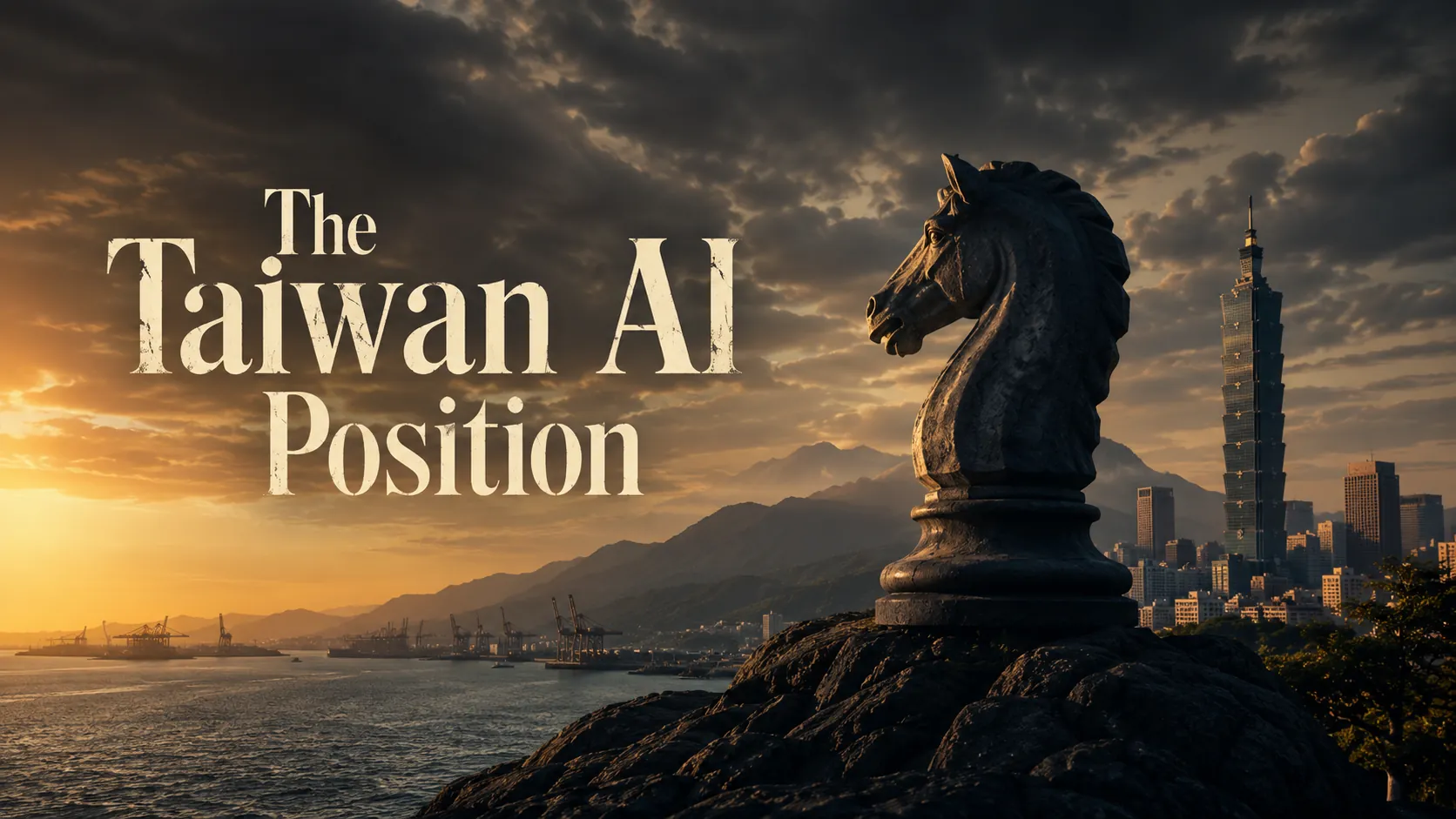
The Taiwan AI Position
Taiwan matters because the advanced AI world depends heavily on its semiconductor manufacturing and the geopolitical risk around that chokepoint.
A different path through the library.

AI feels overwhelming because the ground keeps moving before people can adjust.
Why AI Makes Everyone Feel Behind

Chasing every tool makes you busy without making you clearer.
You Cannot Chase Every Tool

Panic makes everything feel urgent, while learning gives the next step a shape.